
Rwandan delegation meets MOCC&EC State Ministers, vow to jointly work for enhanced climate action, sustainability
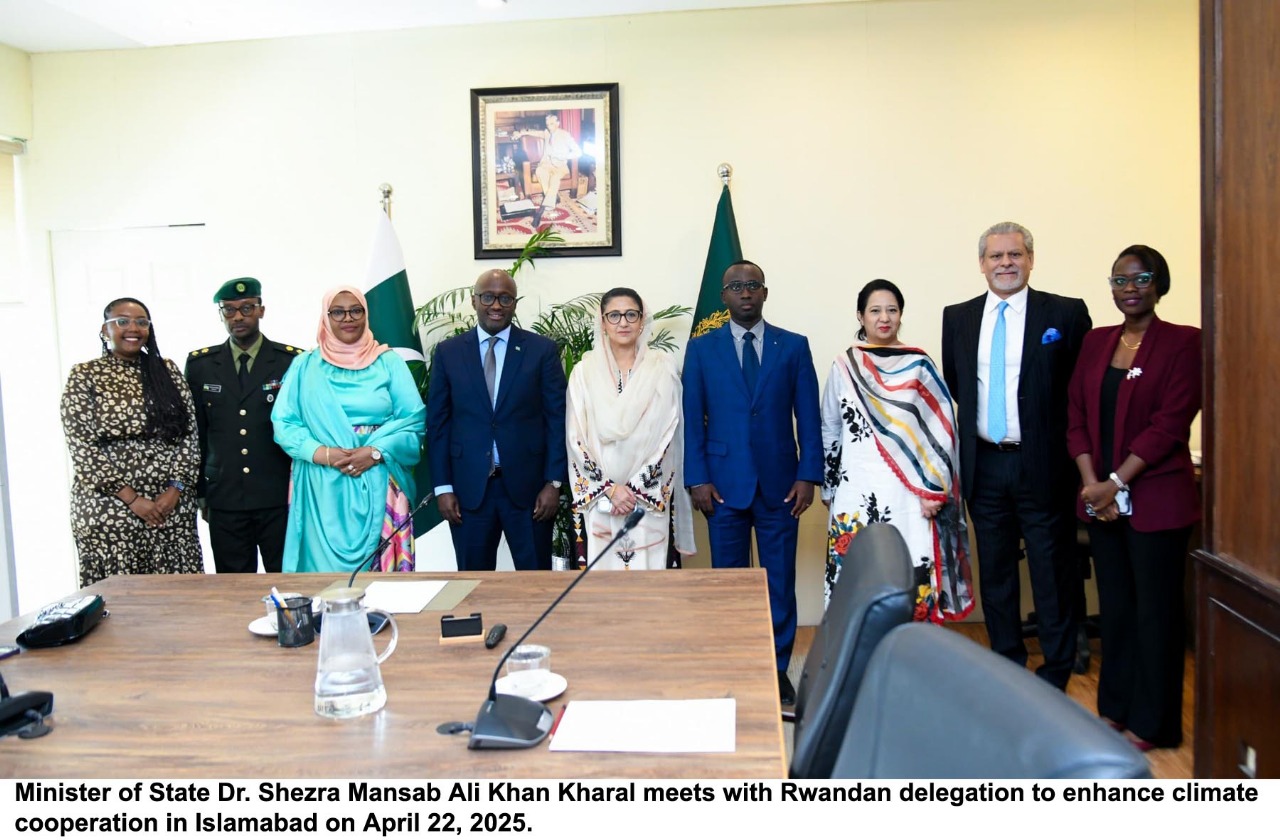
Islamabad (April 22, 2025) - In a landmark step towards advancing global climate cooperation, Pakistan and Rwanda have reaffirmed their commitment to strengthening bilateral ties in the areas of environmental sustainability, climate resilience, and green innovation. The Minister of State for Climate Change and Environmental Coordination, Dr. Shezra Mansab Ali Khan, hosted H.E. Ambassador Olivier J.P. Nduhungirehe, Minister of Foreign Affairs and International Cooperation of the Republic of Rwanda, for a high-level dialogue in Islamabad. Held here at the Ministry of Climate Change & Environmental Coordination's Committee Room, the meeting focused on shared priorities in climate governance, environmental stewardship, and sustainable development. Dr. Shezra Mansab Ali Khan spotlighted Pakistan’s potential in sustainable exports, citing key sectors such as surgical instruments, pharmaceuticals, and sports goods, including world-renowned footballs. She also announced the government’s intent to launch cultural exchange programs with Rwanda to deepen people-to-people connections. Addressing the environmental challenges facing Pakistan, the Minister acknowledged the persistent threat of plastic pollution in the country’s coastal areas. He admitted that while progressive policies have been adopted, enforcement—particularly the plastic ban—faces hurdles due to industry pushback. He expressed strong interest in learning from Rwanda’s success in this area. Ambassador Nduhungirehe shared Rwanda’s globally acclaimed climate strategies, including Kigali’s transformation into a sustainable, smart city driven by green infrastructure and electric public transport. Rwanda’s total ban on plastic bags and single-use plastics, enforced since 2008, was highlighted as a case study in effective environmental regulation. The Ambassador also shared grassroots initiatives such as Umuganda—a monthly national clean-up day—and large-scale reforestation projects, including the Gishwati-Mukura forest corridor restoration. Dr. Shezra emphasized Pakistan’s vulnerability to climate-induced disasters and noted the growing strength of Pakistan’s National Disaster Management Authority (NDMA). He described the NDMA as a technologically advanced body capable of predicting and monitoring both national and global disaster trends. He further outlined Pakistan’s institutional and legislative achievements, including the Pakistan Climate Change Act of 2017, which established the Pakistan Climate Change Council and Authority, as well as the active role of Provincial Environmental Protection Agencies (EPAs). Key initiatives such as the Upscale Green Pakistan Programme, Recharge Pakistan, and projects focused on climate-resilient infrastructure and hazardous waste disposal were also discussed. Both nations expressed a strong commitment to exploring joint ventures, technical collaborations, and investment opportunities in areas like green technology, climate adaptation, and waste management. They reaffirmed their dedication to the goals of the Paris Agreement and pledged to advance South-South cooperation for a more resilient and sustainable future.