
High-level consultative meeting in Murree shapes Pakistan’s climate prosperity strategy
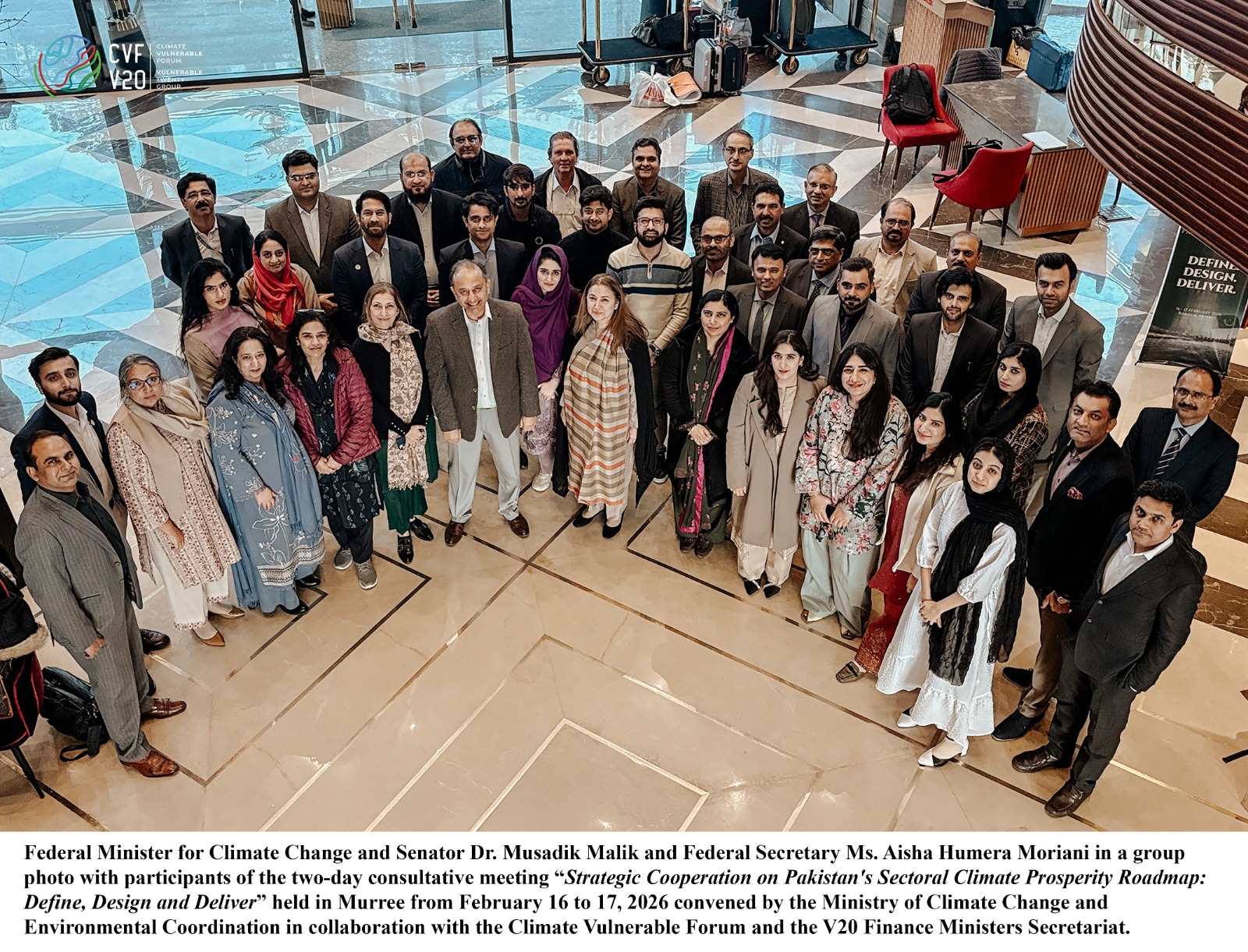
Murree, Pakistan (February 17, 2026) - Senior government officials, development partners and technical experts convened in Murree for a two-day high-level meeting to chart a coordinated and implementation-focused pathway for Pakistan’s climate future, with a focus on advancing the country’s Climate Prosperity Agenda. The meeting, titled “Strategic Cooperation on Pakistan's Sectoral Climate Prosperity Roadmap: Define, Design and Deliver,” was held from February 16 to 17 under the auspices of the Ministry of Climate Change and Environmental Coordination in collaboration with the Climate Vulnerable Forum and the V20 Finance Ministers Secretariat. Federal Minister for Climate Change and Senator Dr. Musadik Malik and Federal Secretary Aisha Humera Moriani addressed the gathering, which brought together 55 participants representing federal ministries and provincial governments including Pakistan Climate Change Authority, Global Change Impact Study Center. Additional Secretary-I Dr. Saad S. Khan, Additional Secretary-II Humera Azam Khan, Joint Secretary (Climate Finance) Khalida Bashir, Joint Secretary (International Cooperation) Nazia Zaib Ali, and Deputy Secretary (Climate Change) Dr. Mazhar Hayat of the Ministry of Climate Change and Environmental Coordination also attended the meeting. Officials described the meeting as a significant step towards developing a results-driven and unified national climate strategy. Structured around a “Define, Design, Deliver” framework, participants outlined national aspirations, identified priority sectors, and worked on setting measurable targets and performance indicators to guide implementation. On the first day, discussions focused on defining Pakistan’s current climate landscape and building a shared vision for 2031, with participants emphasising the need to transform the country into a green and climate-resilient economy. Key deliberations revolved around three pillars: adaptation, mitigation and ecosystems. Experts and policymakers collaborated to develop sectoral missions and strategic directions aligned with development priorities and fiscal realities. The sessions concluded with the identification of outcome-oriented goals across these pillars. The second day shifted towards operational planning, beginning with a review of climate finance flows, gaps and opportunities in Pakistan. This exercise helped inform subsequent discussions on refining priorities and strengthening implementation pathways. Hamza Haroon, Regional Director for West and South Asia at the CVF-V20 Secretariat, highlighted the importance of adopting a country platform approach to better align public and private investments and support long-term climate action. Participants then developed Key Performance Indicators (KPIs) and set ambitious yet achievable targets for 2031, aiming to ensure measurable progress across sectors. Participants agreed that the outcomes of the meeting would guide ongoing efforts to align policy frameworks, financing mechanisms and institutional capacity, as Pakistan advances a more coordinated and implementation-oriented climate prosperity agenda.